

.svg)
.svg)
India’s fintech sector is entering a defining phase as digital payments, embedded finance, and AI-driven financial services continue to reshape the financial ecosystem. From digital lending platforms to global payment infrastructure, fintech companies are expanding rapidly and competing to build stronger technology and product teams.
India’s fintech landscape is witnessing explosive growth, positioning the country as a global hub for jobs and investment. The number of registered fintech startups has increased nearly fivefold, rising from about 2,100 in 2021 to over 10,200 in 2024, highlighting the rapid expansion of the ecosystem.
This surge in innovation and investment is directly influencing fintech workforce expansion in India, as organisations compete for specialised talent in engineering, cybersecurity, product management, and regulatory technology. As fintech companies scale across major innovation hubs, hiring strategies are shifting toward building future-ready teams capable of supporting rapid digital transformation.
In this blog, we explore the key fintech workforce trends shaping India in 2026, the skills companies are prioritising, the hiring challenges they face, and the opportunities emerging for organisations planning to expand their fintech talent pipeline.
Quick Overview
- Fintech in India is booming: Rapid digital adoption, UPI growth, and global investments are driving unprecedented workforce expansion.
- Top hiring roles: Engineering, data science, AI/ML, cloud, cybersecurity, and fintech product leadership are in the highest demand.
- Leading talent hubs: Bengaluru, Mumbai, and Delhi NCR dominate, while Hyderabad, Pune, and Chennai are emerging centres for specialised skills.
- Agile workforce models: Hybrid teams, contract/project-based hiring, and RPO solutions enable fintech firms to scale quickly and efficiently.
- Key hiring challenges: Skill shortages, high attrition, lengthy recruitment cycles, and competition from global tech firms.
- Partnering with experts: V3 Staffing provides specialised recruitment, IT/contract staffing, RPO, and executive search to help fintech companies build high-quality teams across India, the USA, andthe UAE.
Why Fintech Workforce Expansion in India Is Accelerating
India’s fintech ecosystem is entering a new growth cycle driven by digital financial infrastructure, regulatory clarity, and increasing investor confidence. As digital banking, embedded finance, and AI-driven financial services scale rapidly, fintech companies are expanding their workforce to support product development, payment systems, and regulatory compliance.
Recent industry reports show that hiring momentum in fintech strengthened in 2025, with organisations focusing on sustainable growth and specialised talent. This momentum is a key driver of fintech workforce expansionin India, as companies compete for skilled professionals across engineering, compliance, and product development roles.
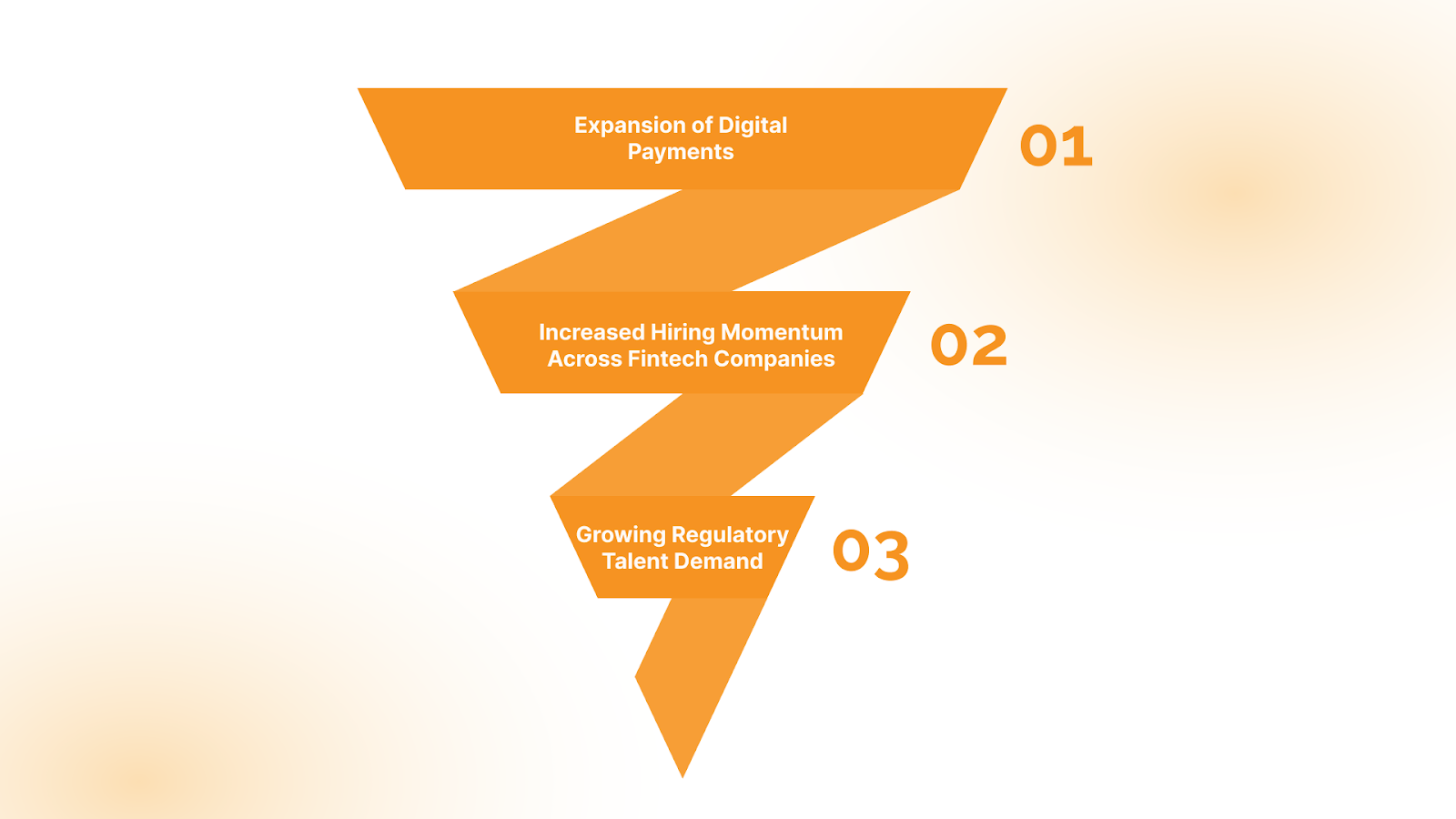
Below are the three major factors accelerating fintech hiring in India.
1. Expansion of Digital Payments and Financial Infrastructure
India’s digital payments ecosystem continues to grow at an unprecedented pace. The success of real-time payment systems and mobile banking has increased transaction volumes and strengthened fintech adoption across the country.
Key developments driving hiring demand include:
- The rapid scale of UPI-based transactions and digital payment platforms requires large engineering and cybersecurity teams to maintain infrastructure.
- Continuous innovation in mobile wallets, payment gateways, and embedded finance platforms.
- Growing demand for payment architects, backend engineers, and security specialists who can maintain high-volume transaction systems.
These developments are forcing fintech firms to expand their technology teams as digital financial services reach more consumers and businesses.
2. Increased Hiring Momentum Across Fintech Companies
Fintech companies regained hiring confidence in 2025 after a cautious funding environment in previous years. Industry reports indicate that workforce planning is now shifting toward sustainable growth and specialised roles.
Key insights from recent hiring reports include:
- The fintech sector recorded a net employment change of +4.5% in the second half of 2025, improving from 3.4% earlier in the year.
- Around 61% of fintech employers reported plans to expand their workforce, reflecting renewed hiring confidence across the industry.
- Hiring priorities increasingly focus on product development, payments architecture, and financial platform engineering.
This renewed hiring momentum is one of the strongest indicators of fintech workforce expansion in India, as companies move from aggressive scaling to more structured, sustainable talent acquisition.
3. Rising Demand for Compliance, Risk, and Regulatory Talent
As the fintech industry matures, regulatory oversight and governance requirements are becoming more significant. Financial regulators are introducing new frameworks for digital lending, data governance, and payment security.
This shift is creating a strong demand for specialised compliance and regulatory talent.
Major hiring trends include:
- Fintech companies are increasingly recruiting AML and KYC compliance specialists, credit risk analysts, and regulatory experts.
- Compliance-related hiring increased by 17–22% in 2025 as companies prepare for stricter oversight and governance frameworks.
- Organisations are strengthening risk management and financial governance teams to maintain regulatory alignment.
As fintech firms scale their platforms, compliance teams are becoming just as critical as engineering and product teams.
Also Read: How India's AI Workforce is Shaping the Future of Jobs in 2026 | V3 Staffing
Top Roles Driving Fintech Workforce Expansion in India
Fintech companies in India are expanding teams across engineering, data, product, and security functions as digital financial services scale. Payment infrastructure, digital lending, and embedded finance platforms require specialised talent capable of building secure and high-volume financial systems.
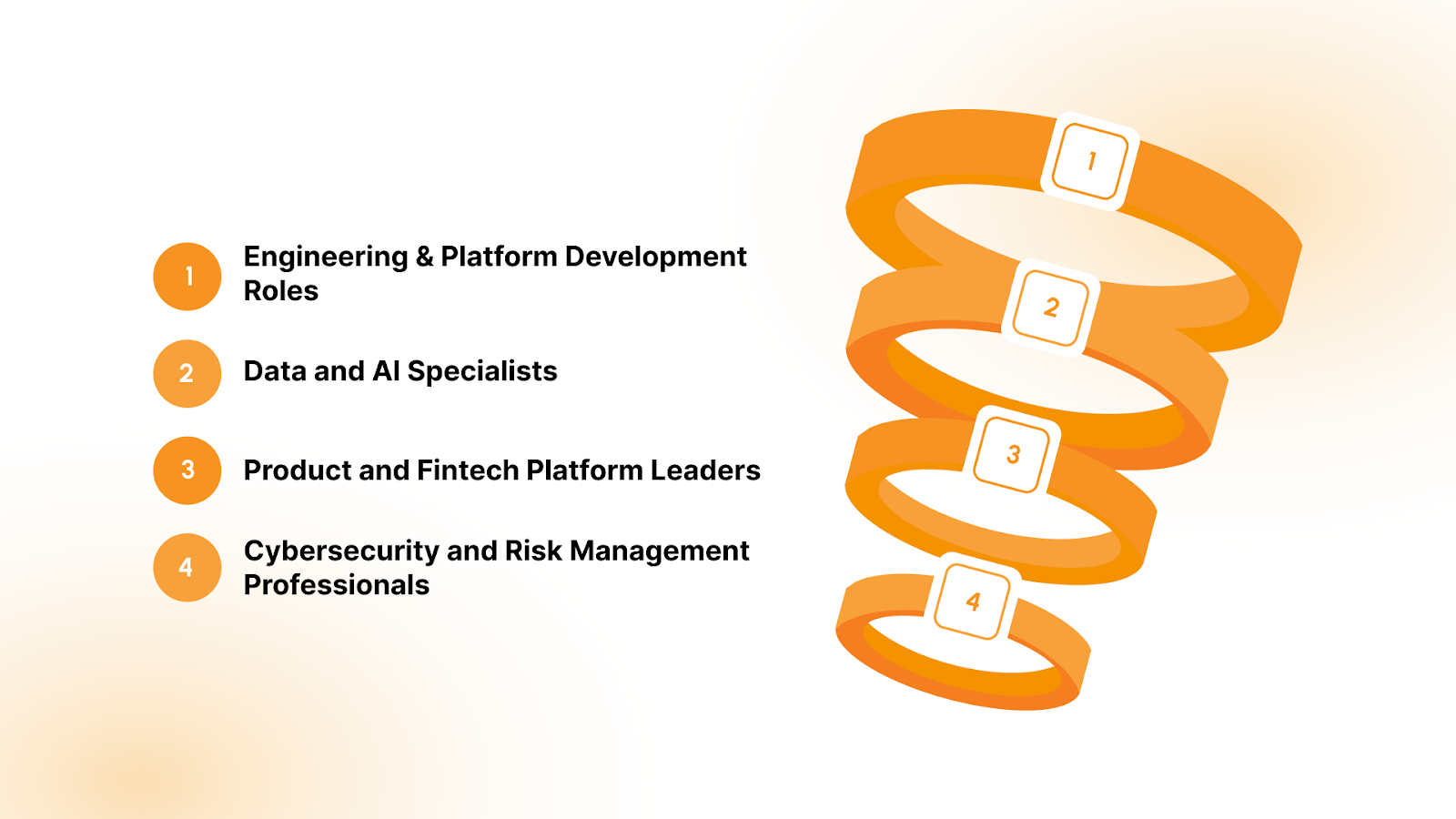
Below are the key roles currently driving hiring across the fintech ecosystem.
1. Engineering and Platform Development Roles
Engineering talent remains the largest hiring segment for fintech companies. Digital payment systems, lending platforms, and banking infrastructure depend on scalable software architecture and secure transaction systems.
Key roles include:
- Backend and Full-Stack Engineers: Build and maintain core systems that power digital banking platforms, payment gateways, and lending applications.
- API Developers and Payment Infrastructure Engineers: Design APIs that connect fintech platforms with banks, payment networks, and third-party financial services.
- Software Architects for Financial Platforms: Develop scalable system architecture capable of handling high transaction volumes and real-time financial processing.
These roles are essential as fintech companies expand transaction platforms and digital financial services.
2. Data and AI Specialists
Fintech platforms rely heavily on analytics and machine learning to improve credit assessment, detect fraud, and optimise financial decision-making.
Key roles include:
- Data Scientists and Machine Learning Engineers: Develop models used in credit scoring, customer behaviour analysis, and predictive financial insights.
- Fraud Analytics Specialists: Identify suspicious transaction patterns and develop automated fraud detection models.
- Risk Modelling Experts: Build risk evaluation frameworks used in digital lending and financial risk management.
The growing use of AI in financial services is increasing demand for advanced data and analytics talent.
3. Product and Fintech Platform Leaders
Fintech companies require product specialists who can manage digital financial platforms while aligning with regulatory requirements and customer experience goals.
Key roles include:
- Fintech Product Managers: Lead the development of digital payment apps, lending platforms, and embedded finance products.
- Digital Banking Product Specialists: Focus on customer-facing banking platforms,s including mobile banking and neobank services.
- Embedded Finance Product Teams: Develop financial products integrated into non-financial platforms such as e-commerce and SaaS applications.
Strong product leadership is critical as fintech firms compete to release new financial services faster.
4. Cybersecurity and Risk Management Professionals
Security and regulatory compliance are major priorities for fintech organisations handling sensitive financial data.
Key roles include:
- Cybersecurity Engineers: Protect fintech platforms from data breaches, cyber threats, and system vulnerabilities.
- Fraud Detection Analysts: Monitor transaction activity and develop fraud prevention strategies.
- Financial Security and Compliance Specialists: Maintain regulatory compliance with financial security standards and governance frameworks.
As fintech platforms scale, demand for cybersecurity and compliance talent continues to rise.
Fintech hiring is also becoming increasingly concentrated in India’s major technology and financial hubs, where fintech startups, banks, and global capability centres are expanding operations.
Also read: GCC Employment Trends and Opportunities in India | V3 Staffing
Major Fintech Hiring Hubs in India
Fintech hiring in India is concentrated in a few major technology and financial centres where venture funding, digital banking infrastructure, and large engineering talent pools intersect. These hubs host the majority of fintech startups, digital payment companies, and financial technology product teams.
According tothe India fintech ecosystem analysis, Bengaluru, Mumbai, and Delhi NCR together host a significant share of India’s fintech startups, while Hyderabad, Pune, and Chennai are emerging as secondary hiring centres.
Key Fintech Hiring Hubs Driving Workforce Expansion
Key Ecosystem Insights
- India has 12,800+ fintech companies with a combined valuation exceeding $125 billion, making it one of the world’s fastest-growing fintech ecosystems.
- The sector ranked third globally for startup funding in H1 2025, raising $889 million, signalling continued investor confidence and startup expansion.
- Bengaluru alone attracted over 55% of fintech funding in H1 2025, reinforcing its position as India’s primary fintech talent hub.
As fintech companies expand across these hubs, hiring strategies are evolving to support rapid product development, regulatory compliance, and secure financial infrastructure.
Fintech organisations looking to scale efficiently rely on experienced recruitment partners like V3 Staffing, which provides contract staffing and RPO solutions to quickly deploy specialised professionals in engineering, cloud, data, cybersecurity, and compliance roles, supporting expansion across India.

Workforce Models Fintech Companies Are Adopting in 2026
As fintech firms move beyond high‑growth scaling to compliance‑driven and sustainable hiring strategies, traditional recruitment methods are no longer sufficient. With 61 % of fintech employers planning workforce expansion in 2025, companies are increasingly using agile workforce models to quickly access specialised skills in engineering, data, compliance, and product leadership.
The three key workforce models fintech companies in India are adopting to support this expansion include hybrid and remote teams, contract/project‑based hiring, and outsourced recruitment models.
1. Hybrid and Remote Workforce Structures
Fintech hiring is shifting toward flexible work structures that blend remote and on‑site talent.
Key features driving adoption:
- Remote engineering teams: Organisations expand talent reach beyond major cities, tapping skilled tech professionals across India.
- Distributed product and analytics teams: Product managers, data scientists, and UX professionals working across locations help accelerate platform enhancements without geographic constraints.
- Cross‑location development teams: Engineering, QA, and DevOps work collaboratively via cloud‑based tooling to support continuous delivery across time zones.
This transition to hybrid models aligns with broader tech workforce trends in India, where flexibility and hybrid work options are becoming standard practice for tech and BFSI roles.
2. Contract and Project‑Based Hiring
Fintech companies are increasingly using contract and project hires to inject specialist capabilities quickly and cost‑effectively.
Common use cases include:
- Cloud transformation specialists: Hired for large‑scale migrations to AWS, Azure, or GCP environments.
- Payment infrastructure implementers: Contract engineers brought in to deploy high‑value payment systems or upgrade APIs.
- Compliance and governance project experts: Short‑term hiring for RBI‑mandated compliance implementations (AML/KYC/data governance).
Industry analyses show that contract and gig engagements are a growing part of the digital workforce strategy in BFSI and fintech, helping firms remain lean while accessing key skills.
3. Recruitment Process Outsourcing (RPO) and Strategic Talent Solutions
As fintech companies scale talent acquisition, many are opting for outsourced recruitment models to manage specialised hiring pipelines and reduce time‑to‑hire for niche profiles.
RPO and outsourcing benefits include:
- Managing large and complex hiring volumes for engineering, data, product, and compliance roles.
- Reducing time‑to‑hire for niche skills, such as AML compliance experts, data scientists, AI/ML engineers, and cybersecurity specialists.
- Improved recruitment scalability, allowing organisations to adapt resource allocation based on hiring demand without expanding internal HR teams.
RPO providers in the Indian market are increasingly bundling AI‑enabled sourcing, diversity hiring, and remote recruitment capabilities to help organisations build more agile hiring engines.
Adopting hybrid, contract, and RPO models enables fintech companies to deploy specialised talent quickly, manage regulatory compliance, and maintain agility in an increasingly competitive hiring environment. In India, fintech hiring momentum continues to grow, with net employment changes up to +4.5 % in H2 2025.
Challenges Slowing Fintech Workforce Expansion in India
Despite India’s booming fintech ecosystem, companies face several hurdles in scaling their talent efficiently. Rapid growth, niche skill requirements, and competitive pressures make workforce expansion a complex task for fintech organisations.
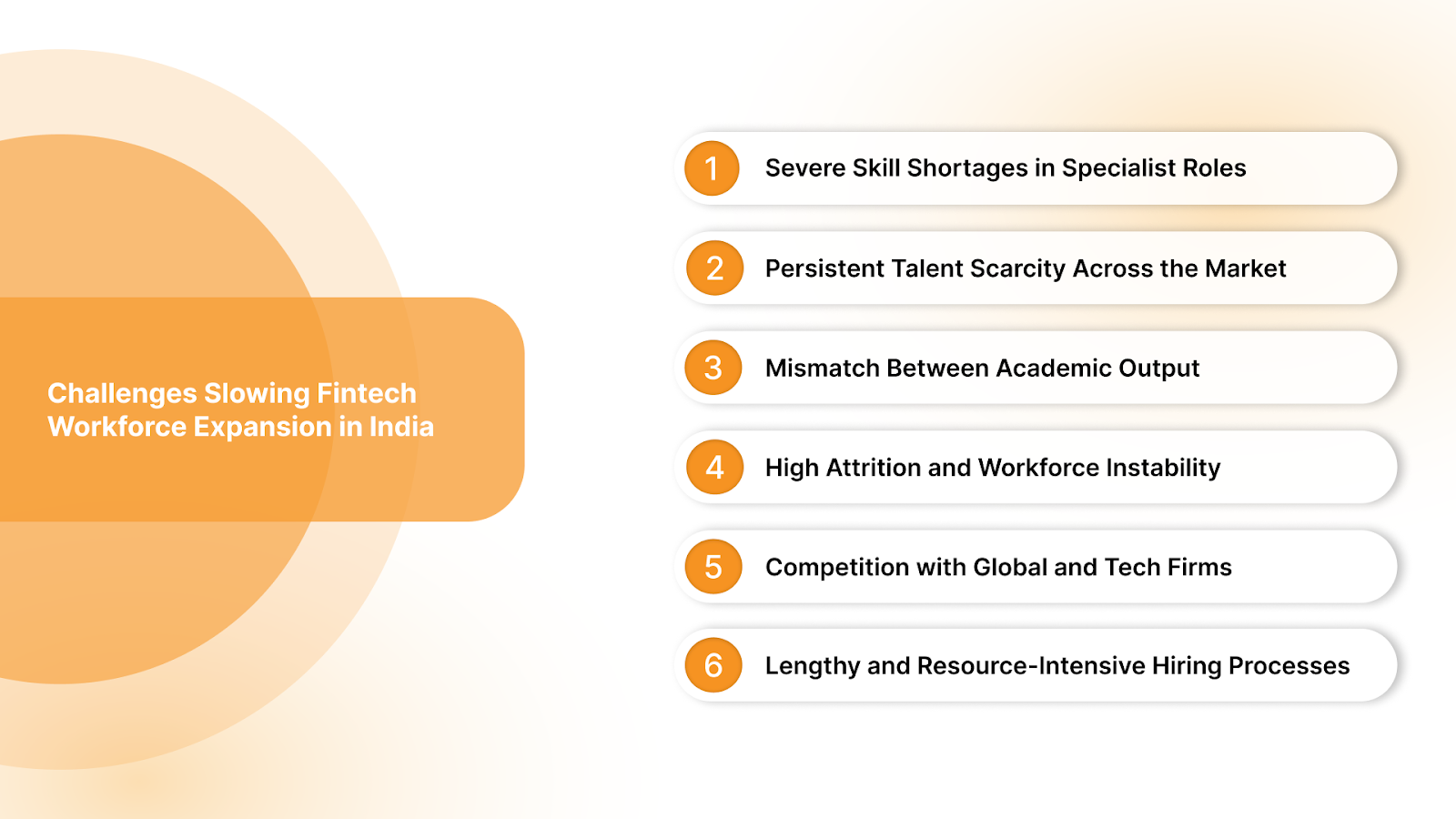
- Severe Skill Shortages in Specialist Roles: Growing demand-supply gaps for AI engineers, payment systems developers, cybersecurity specialists, and risk modelling experts.
- Persistent Talent Scarcity Across the Market: Over 80 % of employers report difficulty in finding qualified candidates for fintech and BFSI roles.
- Mismatch Between Academic Output and Fintech Requirements: Graduates often lack fintech-specific skills such as compliance, payments architecture, or product-centric expertise.
- High Attrition and Workforce Instability: Churn among early-career tech and operations staff disrupts continuity and slows team scaling.
- Competition with Global and Tech Firms: Fintech companies compete with global tech players and BFSI incumbents offering better pay and career paths.
- Lengthy and Resource-Intensive Hiring Processes: Multi-stage assessments, regulatory checks, and background verification slow recruitment cycles.
Overcoming these challenges requires strategic hiring models, targeted skill sourcing, and agile workforce planning to sustain India’s fintech growth trajectory.
How V3 Staffing Supports Fintech Workforce Expansion in India
Fintech companies scaling talent across engineering, product, data, cloud, AI/ML, and cybersecurity often need recruitment partners who can deliver speed, precision, and domain expertise. V3 Staffing provides this strategic support with a comprehensive hiring ecosystem designed for high‑growth organisations facing complex talent needs.
- V3 Staffing specialises in hiring specialised professionals across critical functions,s including engineering, product management, data science, AI/ML, cloud computing, and cybersecurity, ensuring companies access talent that matches precise technical and business requirements.
- It supports fintech companies scaling across India, tapping into extensive regional networks and industry insights to place talent in major hubs and emerging tech centres.
- Through flexible workforce solutions such as IT Staffing and Contract Staffing, V3 enables organisations to scale teams quickly for project demands or peak workload periods without long‑term commitments.
- Its Recruitment Process Outsourcing (RPO) services manage the full hiring lifecycle from sourcing and screening to candidate engagement and onboarding, reducing time‑to‑hire for specialised and volume roles.
- V3 also provides Executive Search support to place senior leadership and strategic roles that drive fintech innovation and organisational growth.
By combining domain expertise with scalable hiring models, V3 Staffing helps fintech organisations build resilient, future‑ready teams globally, aligning talent acquisition with business strategy and growth objectives.

Conclusion
India’s fintech sector is witnessing rapid growth, driven by digital adoption, expanding startups, and evolving payment habits. This surge is creating demand for specialised talent in engineering, data, AI/ML, cloud, cybersecurity, and product leadership. While major hubs like Bengaluru, Mumbai, and Delhi NCR attract top talent, emerging cities such as Hyderabad, Pune, and Chennai are becoming critical centres for workforce expansion. Companies adopting hybrid teams, project-based hiring, and RPO models are better positioned to scale efficiently.
V3 Staffing helps fintech organisations overcome these hiring challenges with domain-specialised recruitment, flexible workforce solutions, and end-to-end RPO services. Their expertise covers engineering, data science, cloud, cybersecurity, and strategic executive hires. Partnering with V3 Staffing enables companies to build high-quality teams across India, the USA, and the UAE.
Contact our experts today to scale your fintech workforce with speed, precision, and confidence.