
.svg)
.svg)
Organisations across India, the USA, and the UAE are facing increasingly complex hiring conditions. According to the 2025 Annual Job Search Trends Report, the median time to a first job offer increased from 57 days in Q1 to 83 days in Q4 2025, highlighting how prolonged hiring cycles are becoming a significant operational challenge for employers.
For mid‑size and enterprise businesses, especially Global Capability Centres (GCCs), product and platform tech firms, BFSI institutions, engineering and manufacturing companies, and shared service centres, the pressure to fill roles at scale while maintaining quality is intensifying. Talent acquisition leaders, HR directors, CHROs, and delivery managers must now balance speed with precision, ensuring that high‑volume recruitment delivers skilled hires without weakening candidate experience or internal workflows.
This blog explains what high volume recruitment means, why it matters, and the strategies organisations can adopt to address large‑scale hiring challenges effectively.
Key Takeaways
- High-volume recruitment fills multiple roles quickly while ensuring quality and compliance.
- Structured processes and scalable workflows make hiring faster and more consistent.
- Challenges include mis-hires, manual screening overload, skill misalignment, and scaling across teams.
- Key strategies: build talent pipelines, use AI screening, automate workflows, run group hiring events, and maintain candidate experience.
- Common mistakes: poor planning, overreliance on automation, neglecting candidate engagement, and weak employer branding.
- Partnering with V3 Staffing ensures SLA-driven, scalable recruitment across India, the USA, and the UAE for IT, BFSI, GCCs, Engineering, and startups.
What is High Volume Recruitment?
High volume recruitment is the process of hiring large numbers of candidates quickly while maintaining quality, compliance, and a positive candidate experience. Unlike traditional recruitment, which focuses on individual specialised roles, this approach requires structured planning, scalable workflows, and technology-driven processes to fill multiple vacancies efficiently.
It is critical for organisations facing rapid expansion, project-based hiring, or multi-location operations. Technology firms scaling product teams, GCCs expanding shared service centres, BFSI institutions onboarding multiple roles, and startups hiring across functions rely on high-volume recruitment to meet workforce targets.
Why a Structured High-Volume Hiring Approach Matters
High-volume recruitment succeeds only when it is supported by a clearly defined hiring framework. Without structure, scale quickly turns into operational chaos, slowing hiring and increasing risk.
- Better use of recruitment resources: Structured workflows bring clarity to sourcing, screening, and decision-making, allowing hiring teams to manage volume without burning internal bandwidth.
- Consistent candidate engagement: Clear stages, automated updates, and defined follow-ups help prevent drop-offs and maintain trust, even when applicant volumes are high.
- Stronger quality control: Role clarity, standardised assessments, and uniform screening criteria improve shortlisting accuracy and reduce the chances of mis-hiring at scale.
- Scalability without disruption: A structured approach supports sudden hiring spikes through ready talent pools, flexible workflows, and supporting technology.
- Measurable hiring performance: Defined processes allow organisations to track outcomes such as time-to-hire, offer conversion, and hiring effectiveness, enabling informed course correction.
When high-volume hiring is treated as a strategic process rather than a reactive task, organisations are far better positioned to scale teams, protect hiring quality, and sustain long-term workforce performance.
Also read: Explore Types of Recruitment to Improve Hiring in 2025 - V3Staffing
6 Common Challenges in High-Volume Hiring
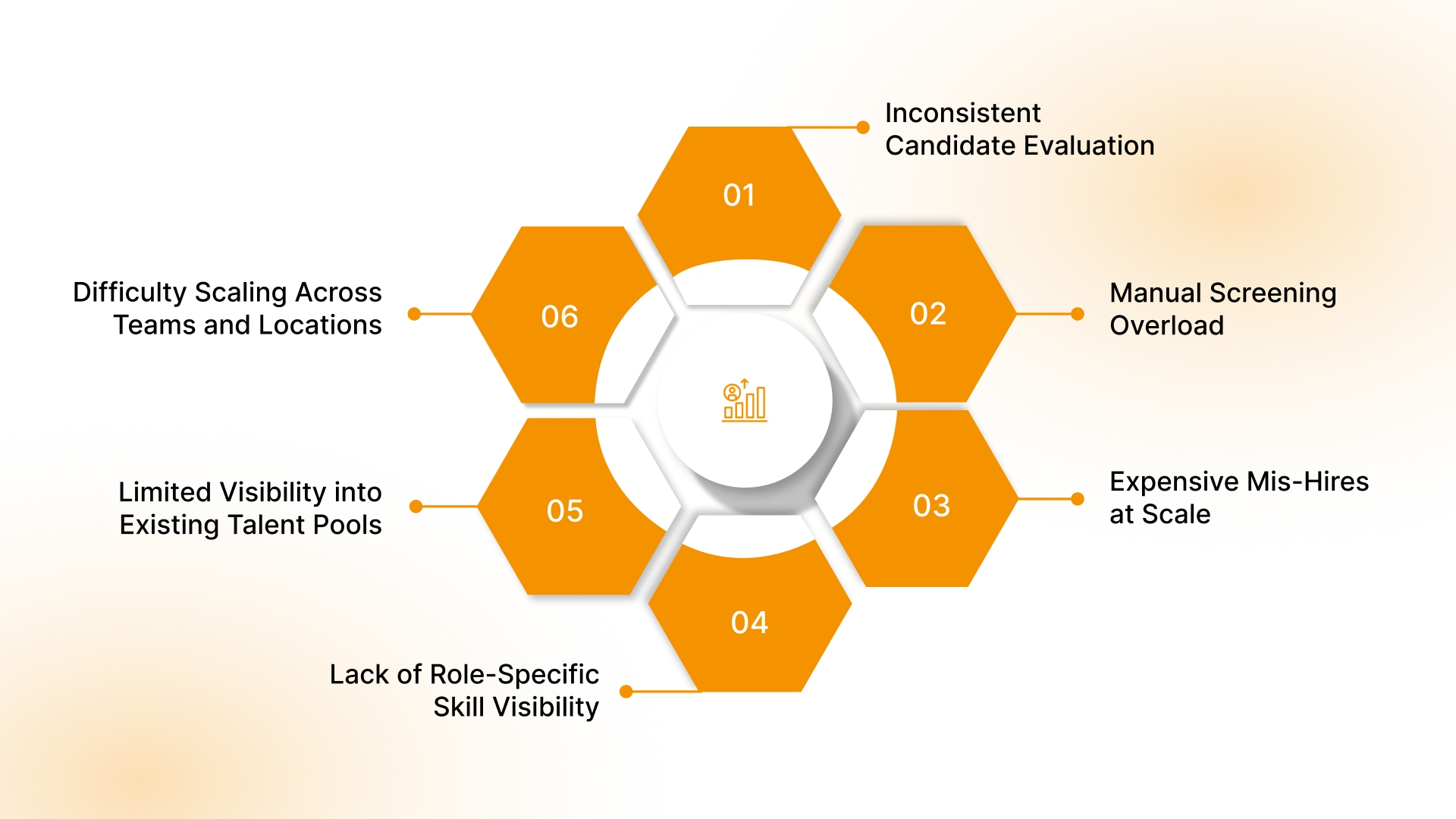
Scaling hiring across multiple roles, teams, and timelines places consistent pressure on talent acquisition functions. When recruitment volumes increase, gaps in process, visibility, and decision-making become far more visible, directly impacting hiring speed and quality.
1. Inconsistent Candidate Evaluation
When screening relies heavily on CV reviews or unstructured interviews, candidate assessment becomes subjective. Different recruiters evaluate profiles differently, making it difficult to compare candidates fairly across large batches. Over time, this inconsistency leads to poor role fit and higher early attrition.
2. Manual Screening Overload
High application volumes can overwhelm recruitment teams when screening is largely manual. Recruiters spend excessive time reviewing profiles instead of engaging qualified candidates. This delay often results in strong applicants exiting the process or accepting competing offers before decisions are made.
3. Expensive Mis-Hires at Scale
In high-volume hiring, even a small percentage of wrong hires creates a significant cost impact. Retraining, replacement hiring, productivity loss, and team disruption multiply quickly when roles are filled at scale without sufficient validation.
4. Lack of Role-Specific Skill Visibility
Generic job descriptions and surface-level screening fail to assess the skills that actually determine on-the-job performance. This disconnect leads to candidates progressing through the process without being evaluated against real business requirements.
5. Limited Visibility into Existing Talent Pools
Many organisations lack a structured view of past applicants, silver-medal candidates, or internal talent. As a result, hiring teams repeatedly source externally, increasing cost and time-to-hire while missing opportunities for internal mobility.
6. Difficulty Scaling Across Teams and Locations
When recruitment processes vary by team or geography, hiring outcomes become uneven. Without a unified framework, maintaining consistent quality, compliance, and candidate experience across locations becomes increasingly difficult.
This is where a structured high-volume recruitment partner makes a measurable difference. V3 Staffing supports organisations facing these challenges by introducing standardised screening, scalable hiring frameworks, and accountable delivery models that allow high-volume hiring to move faster without compromising quality.

10 High Volume Recruitment Strategies

Effective high-volume recruitment requires organisations to balance speed, quality, and candidate experience. Implementing the right strategies ensures that mass hiring campaigns are efficient, sustainable, and aligned with business objectives. The strategies below are widely used by leading organisations to manage multiple roles, maintain hiring standards, and meet workforce targets consistently.
1. Build a Scalable Talent Pipeline Before Hiring Peaks
Building a scalable talent pipeline ensures organisations are ready to meet hiring demands without delays or compromise on quality. Proactively sourcing and maintaining candidates allows recruiters to fill multiple roles efficiently when demand spikes.
Actionable strategies:
- Segment talent pools: Maintain separate pipelines for tech, finance, shared services, and leadership positions to ensure rapid access to qualified candidates.
- Engage passive candidates: Keep potential hires warm through regular communication, newsletters, and updates about your company.
- Collaborate with educational and training institutes: Access emerging talent early, particularly for high-demand roles in tech and shared services.
- Maintain pre-screened candidate databases: Regularly update candidate profiles for quick deployment during peak hiring periods.
2. Automate Recruitment Workflows and Processes
Automation is essential in high-volume recruitment to reduce repetitive administrative work and allow teams to focus on high-value activities. Well-implemented workflows streamline operations and improve overall hiring efficiency.
Actionable strategies:
- Automated resume parsing: Quickly categorise applications by skills and experience to reduce manual screening.
- Interview scheduling automation: Integrate calendars to schedule interviews automatically and send reminders.
- Pre-screening questionnaires: Filter candidates based on essential criteria before human evaluation.
- Streamlined internal approvals: Automate offer approvals, feedback collection, and status updates to maintain hiring speed.
3. Use AI-Driven Screening and Shortlisting Tools
AI-driven screening accelerates candidate evaluation and ensures high-quality shortlisting while handling large volumes of applications. It reduces manual effort and improves accuracy in matching candidates to roles.
Actionable strategies:
- Skill and experience matching: Highlight candidates whose qualifications and experience best align with the role.
- Predictive assessment: Use historical and behavioural data to anticipate candidate success.
- Bias reduction: Configure AI tools to mitigate unconscious bias in initial screening.
- Continuous learning: Regularly refine algorithms based on recruiter feedback to maintain shortlisting accuracy.
4. Simplify and Optimise the Application Experience
A frictionless application process improves candidate conversion rates and reduces drop-offs, which is critical during high-volume recruitment drives. Clear and simple application flows ensure candidates remain engaged throughout the process.
Actionable strategies:
- Minimal required fields: Collect only essential information to avoid candidate fatigue.
- Mobile-friendly applications: Enable seamless submission across devices.
- Resume/profile integrations: Allow LinkedIn or document uploads for faster application completion.
- Clear communication of role requirements: Set expectations upfront to attract the right candidates efficiently.
5. Conduct Video and Asynchronous Interviews
Video and asynchronous interviews are critical in high volume recruitment where speed and consistency matter. These formats allow hiring teams to assess large candidate pools without scheduling bottlenecks or interviewer fatigue.
Actionable strategies:
- Standardise interview frameworks: Use the same structured questions across roles to ensure fair and comparable evaluations.
- Asynchronous first-round interviews: Record candidate responses to role-specific questions to shortlist efficiently before live interviews.
- Panel interview optimisation: Reduce interview rounds by involving decision-makers earlier through virtual panels.
- Interview scoring templates: Enable faster decision-making by capturing interviewer feedback in real time within the ATS.
6. Engage and Communicate With Candidates at Scale
Consistent and timely communication plays a major role in reducing candidate drop-offs during high volume hiring. When candidates feel informed, they remain engaged and are more likely to complete the process and accept offers.
Actionable strategies:
- Automated status updates: Keep candidates informed at every stage to eliminate uncertainty and follow-ups.
- Segmented communication: Tailor messaging based on role type, hiring stage, or location to stay relevant.
- Centralised communication platforms: Manage emails, SMS, and notifications from a single system for consistency.
- Clear hiring timelines: Set expectations early so candidates understand process duration and next steps.
7. Implement Employee Referral Programs and Incentives
Employee referrals remain one of the most reliable sources for quality hires in high volume recruitment. Structured referral programmes help organisations scale faster while maintaining cultural and skill alignment.
Actionable strategies:
- Role-specific referral campaigns: Focus referrals on hard-to-fill or high-demand roles to improve relevance.
- Clear incentive structures: Define rewards, timelines, and eligibility criteria to drive participation.
- Fast-track referred candidates: Prioritise referrals in screening to improve conversion and employee trust.
- Regular referral performance reviews: Track success rates to refine and optimise the programme.
8. Make Data-Driven Recruitment Decisions
High volume recruitment generates large amounts of hiring data, which becomes valuable only when analysed effectively. Data-driven decision-making helps organisations improve speed, quality, and predictability in hiring outcomes.
Actionable strategies:
- Track critical hiring metrics: Monitor time-to-hire, cost-per-hire, source performance, and offer acceptance rates.
- Identify process bottlenecks: Use data to pinpoint delays in screening, interviews, or approvals.
- Quality-of-hire analysis: Measure post-joining performance and retention to refine sourcing strategies.
- Forecast hiring demand: Use historical data to anticipate future workforce needs and resource planning
9. Organise Group Hiring Events and Virtual Job Fairs
Group hiring events and virtual job fairs allow organisations to engage large candidate pools in a compressed timeframe. When executed with structure, they significantly reduce time-to-hire while maintaining screening discipline.
Actionable strategies:
- Pre-event candidate shortlisting: Screen applications in advance to ensure only relevant profiles attend interviews or assessments.
- Role-based hiring tracks: Segment candidates by function or skill set to avoid interviewer overlap and delays.
- Centralised interview coordination: Use real-time scheduling and shared interview panels to manage volume efficiently.
- Same-day decision workflows: Enable interviewers and hiring managers to align on selections immediately after evaluations.
10. Maintain Candidate Experience in High Volume Recruitment
Candidate experience directly impacts offer acceptance, employer brand, and future hiring success. In high volume recruitment, maintaining consistency and respect across thousands of interactions is a strategic requirement, not a soft metric.
Actionable strategies:
- Process transparency: Clearly communicate stages, timelines, and evaluation criteria to reduce candidate uncertainty.
- Consistent evaluation standards: Ensure fairness by applying the same assessment criteria across all applicants.
- Responsive support channels: Provide timely responses to candidate queries through automated and human touchpoints.
- Closure communication: Inform all candidates of outcomes to preserve goodwill and long-term talent pools.
Also read: Top 5 Effective RPO Strategies for Mass Hiring - V3Staffing
Common Mistakes to Avoid in High Volume Recruitment
High-volume hiring requires precision, planning, and consistency. When these elements are overlooked, organisations often struggle with delays, quality issues, and increased hiring costs.
- Poor pipeline planning: Hiring becomes reactive when talent pools are not built in advance. This leads to rushed decisions, longer hiring cycles, and inconsistent candidate quality during peak demand.
- Overreliance on automation: Excessive dependence on screening tools without human oversight can filter out suitable candidates. Automation should support recruiters, not replace contextual evaluation.
- Neglecting candidate experience: Delayed communication, unclear timelines, and lack of closure reduce candidate trust. In high-volume hiring, poor experience directly impacts offer acceptance rates.
- Ignoring data and recruitment analytics: Without tracking metrics such as time-to-hire and source effectiveness, inefficiencies remain hidden. Data-driven insights are essential to improve hiring outcomes at scale.
- Weak employer branding: Inconsistent role messaging and unclear value propositions reduce candidate engagement. Strong employer branding helps attract candidates who are more likely to convert and stay.
When organisations address these common gaps early, high-volume recruitment becomes faster, more predictable, and easier to scale without compromising hiring standards.
Also read: How Predictive Analytics is Revolutionizing Talent Acquisition
How V3 Staffing Supports Your High-Volume Recruitment
Managing large-scale hiring across multiple functions and locations requires speed, precision, and consistency. V3 Staffing provides tailored, scalable recruitment solutions that address these challenges while ensuring quality and candidate engagement.
- Global recruitment reach: V3 Staffing delivers solutions for organisations operating in India, the USA, and the UAE, providing seamless hiring support across multiple geographies.
- SLA-driven and technology-enabled hiring: Structured workflows, AI-assisted screening, and applicant tracking systems ensure fast and reliable recruitment while maintaining accountability.
- Industry and domain expertise: Extensive experience in IT, BFSI, Engineering, GCCs, and high-growth startups enables precise matching of candidates to specialised and volume roles.
- End-to-end recruitment services: V3 Staffing offers Permanent Recruitment, Temporary Staffing, IT Staffing, RPO, and Executive Search, supporting both mass hiring and niche talent acquisition.
- Consultation and strategic support: Organisations gain actionable insights through process optimisation, case studies, and tailored hiring frameworks to reduce time-to-hire and improve candidate quality.
Partnering with V3 Staffing ensures that high-volume recruitment becomes predictable, scalable, and efficient, allowing your organisation to focus on growth while maintaining a strong employer brand and candidate experience.

Conclusion
High-volume recruitment is a strategic process that enables organisations to scale teams quickly while maintaining hiring quality and a positive candidate experience. By combining structured workflows, technology, and data-driven insights, companies can overcome the challenges of managing large-scale hiring across multiple functions and locations.
V3 Staffing provides scalable, SLA-driven recruitment solutions tailored for enterprises, GCCs, and high-growth startups. With expertise across IT, BFSI, Engineering, and shared services, we ensure your high-volume hiring targets are met efficiently without compromising candidate quality.
Reach out to our experts today to build a reliable and scalable hiring engine that aligns with your business goals.