

.svg)
.svg)
Hiring at scale presents organisations with unique challenges. Standard recruitment methods strain internal HR teams, extend hiring timelines, and often fail to deliver consistent quality when the volume of roles grows. Mass hiring RPO (Recruitment Process Outsourcing) structures hiring operations to enable companies to fill large numbers of positions quickly while maintaining high standards and controlling costs.
According to industry insights, 96 % of organisations that adopt RPO report improved hiring metrics. This includes better role matching, process efficiency, and candidate quality than traditional recruitment approaches.
This blog provides a detailed, strategy‑focused guide on RPO frameworks suited for mass hiring. You'll learn how RPO transforms recruitment into a measurable, scalable function backed by practical insights and proven practices.
Key Takeaways
- Mass-hiring RPO streamlines large-scale recruitment with structured, scalable solutions aligned with business goals.
- Partnering with an RPO provider offers improved access to talent pools, a better candidate experience, and efficient resource management.
- RPO helps organisations adapt to fluctuating hiring demand and ensures consistent recruitment outcomes.
- Key strategies for successful mass hiring include segmenting roles, maintaining talent pools, standardising screening, and automating communication.
- Metrics like time-to-fill, cost-per-hire, candidate satisfaction, and retention rates measure success in mass hiring.
What Is Mass Hiring RPO and Why It Works
Mass hiring RPO is not simply outsourcing a few positions. It is a strategic partnership in which an external provider assumes responsibility for the entire recruitment lifecycle during periods of high‑volume demand.
RPO providers work as an extension of your internal team, managing sourcing, screening, interviewing, offer management, and onboarding at scale.
This integrated model helps organisations replace fragmented hiring efforts with structured, repeatable processes that perform reliably when volumes spike.
The Role of RPO in Large‑Scale Hiring Needs
When a company needs to hire hundreds or thousands of employees within a short timeframe, traditional recruitment becomes inefficient and error‑prone. Mass hiring RPO serves three core purposes:
- Consistent Process Execution: RPO providers establish workflows to manage high volumes of candidates using standardised evaluation criteria.
- Specialised Talent Pools: Providers build and maintain pipelines for roles that recur frequently or demand specific skill sets.
- Operational Load Sharing: Internal HR teams are freed from administrative overload, allowing them to maintain focus on organisational priorities.
Market Growth Confirms Adoption
The global RPO market continues to expand rapidly, reflecting its increasing relevance. According to industry reports, the global RPO market was valued at USD 9.4 billion in 2024 and is projected to reach USD 36.4 billion by 2033. Expansion is driven by the need for efficient recruitment amid talent shortages and competitive hiring environments.
Also Read: Challenges in Leadership Hiring: Common Issues and Solutions

To make mass hiring RPO work for your business, it's essential to structure your approach to support your specific hiring needs. Here's how to set up an RPO model that scales effectively.
Designing a Mass Hiring RPO Strategy That Delivers Results
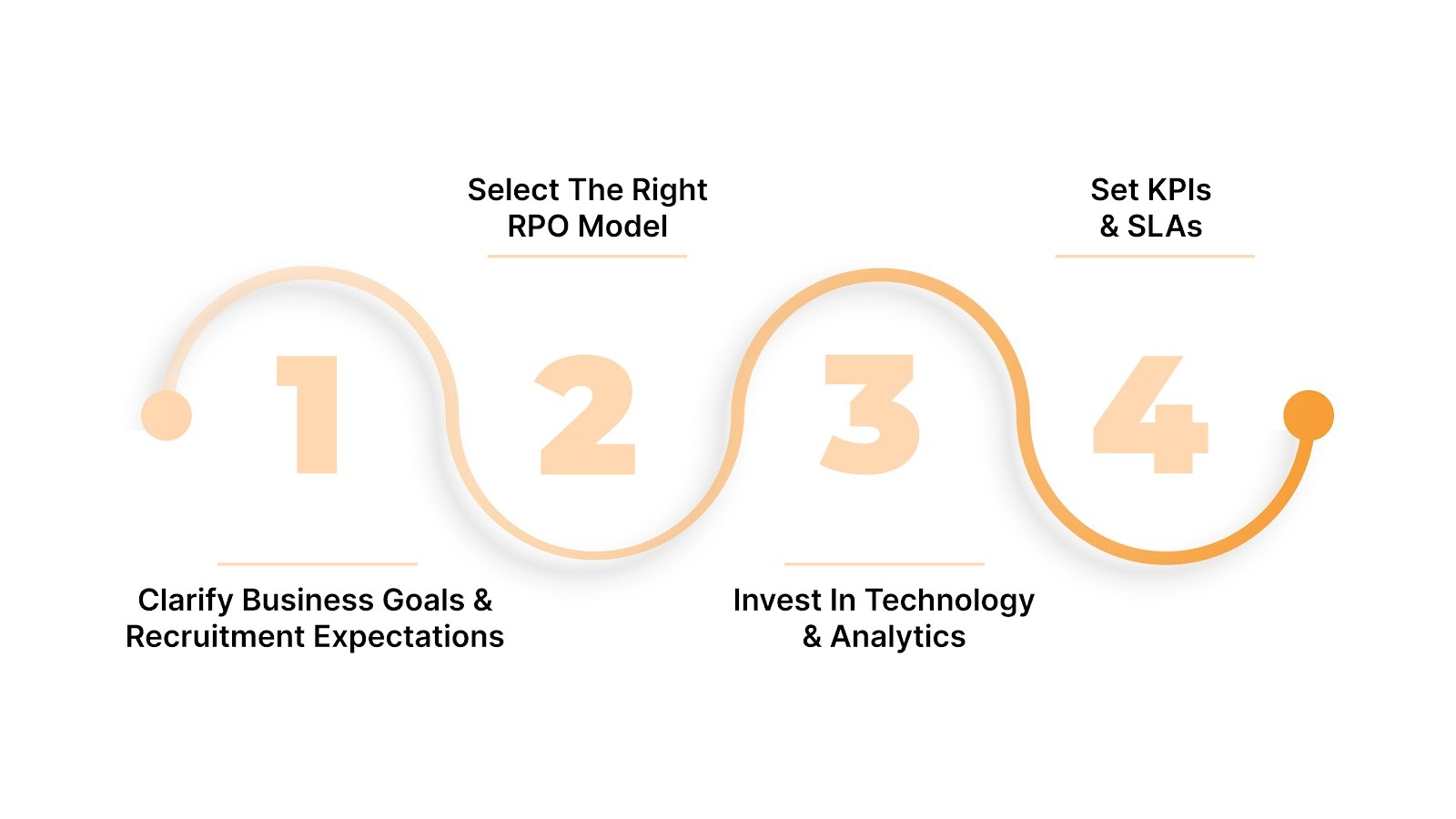
For mass recruitment, partial or ad‑hoc outsourcing will not sustain performance. A deliberate strategy comprising several interconnected components is essential.
1. Clarify Business Goals and Recruitment Expectations
Before implementing RPO:
- Define hiring volumes by role and timeline.
- Prioritise roles according to impact and urgency.
- Set quality criteria tied to performance outcomes.
- Decide where hiring will take place. Either in Indian cities such as Hyderabad and Bengaluru, or in regions where recruitment standards align with practices common in markets like the USA and the UAE.
Clear expectations form the foundation for KPIs, SLAs, and predictive planning.
2. Select the Right RPO Model
RPO engagements vary by scope and flexibility. Common models include:
Choosing a model that matches your hiring rhythm ensures resources are neither underutilised nor overwhelmed.
3. Invest in Technology and Analytics
A high‑volume hiring strategy must include recruitment technology such as:
- Applicant Tracking Systems (ATS) for pipeline visibility
- Automated screening tools to categorise candidates rapidly
- Dashboard reporting for real‑time performance insights
Data‑driven RPO engagements track metrics such as time‑to‑fill, cost‑per‑hire, and candidate-source effectiveness. Transparency in these metrics helps refine the approach and optimise performance for subsequent hiring waves.
4. Set KPIs and SLAs
Mass hiring RPO succeeds when partners are accountable. Define key performance indicators (KPIs) such as:
- Time‑to‑shortlist
- Offer acceptance rate
- Candidate quality scoring
- Retention of hires at 90 days
Service-level agreements (SLAs) for these indicators ensure measurable delivery and continuous improvement.
Scale Your Hiring Process with V3 Staffing. V3 Staffing provides expert RPO solutions designed for mass hiring. With our industry-specific expertise and scalable recruitment models, we help organisations fill high‑volume roles quickly and efficiently, ensuring high‑quality talent across diverse sectors.
Quantifiable Benefits of Mass Hiring RPO

Mass hiring RPO (Recruitment Process Outsourcing) offers tangible, measurable benefits that directly impact a company's ability to scale its workforce efficiently and cost-effectively, including:
1. Faster Recruitment Cycles
Without structured strategies, the average time to fill a role can exceed 40 days. Mass hiring initiatives require speed because lengthy hiring cycles translate into lost productivity and project delays.
2. Cost Savings Across the Board
RPO directly lowers recruitment costs by reducing reliance on multiple recruitment agencies, eliminating redundant postings, and standardising workflows. Studies indicate that organisations can reduce total hiring costs by up to 30–40%.
3. Improved Quality of Hires
RPO partners develop targeted sourcing strategies for specific roles and maintain detailed candidate profiles, resulting in higher match quality.
4. Enhanced Scalability and Flexibility
Mass hiring needs can fluctuate dramatically due to seasonal demand or business expansion. RPO models enable organisations to scale their recruitment function up or down without adding fixed HR headcount, aligning capacity with demand.
Stronger Candidate and Hiring Manager Experience
Well‑structured RPO processes ensure consistent communication, candidate care, and efficient interview handling, improving satisfaction scores for both candidates and internal stakeholders.
Also Read: How Are Hiring Managers Responsible for Candidate Engagement?
Now that we know the benefits, let's dive into actionable strategies you can implement to optimise your RPO processes and drive better outcomes in high-volume hiring.
5 Operational Strategies for High‑Volume Recruitment
Implementing an effective mass-hiring RPO strategy requires combining structured processes, technology, and disciplined execution. The goal is to manage high applicant volumes while maintaining candidate quality and recruitment efficiency.
Below are action‑oriented strategies that organisations can adopt immediately:
1. Segment Roles Based on Priority and Function
High‑volume hiring efforts become more efficient when job categories are segmented rather than treated uniformly.
- Tier 1 – Core Technical Roles: These include specialised functions such as cloud engineers and data scientists, where screening must emphasise validating skills.
- Tier 2 – Operational or Frontline Roles: These roles often require repeatable evaluation criteria that can be executed at scale.
- Tier 3 – Leadership or Strategic Hires: Although fewer in number, these require deeper assessment and a separate evaluation flow.
Segmenting roles helps RPO teams tailor sourcing channels, evaluation tools, and screening protocols to each category, reducing decision fatigue and improving outcome quality.
Modern high‑volume hiring frameworks emphasise such segmentation to ensure consistency and repeatable processes across hundreds of requisitions.
2. Create and Maintain Active Talent Pools
Rather than sourcing reactively, proactive candidate engagement builds pipelines before roles open.
- Maintain talent pools for recurring requirements.
- Engage with passive candidates with periodic updates and personalised communication.
- Mobilise talent lists ahead of seasonal or expected hiring surges to reduce cycle time when demand peaks.
Studies on high‑volume recruitment show that proactive engagement and early pipeline building are critical for handling large applicant volumes without sacrificing quality.
3. Standardise Screening and Assessment Tools
Standardisation ensures fairness and quality across the entire pipeline, which is crucial when processing hundreds or thousands of applications.
- Use structured assessments tied to role competencies.
- Implement automated pre‑screening to filter at scale.
- Align scoring rubrics with hiring manager expectations and outcomes you expect after onboarding.
Leading RPO strategies combine structured assessment frameworks with defined competency models to maintain hiring quality even under high volume.
4. Optimise Candidate Communication Workflows
High candidate drop‑off rates often stem from poor touchpoints or delayed communication during the recruitment funnel.
- Use templated updates for key stages (acknowledgement, shortlisting, interview invites).
- Automate reminders and next steps while maintaining a human touch where it matters.
- Brief candidates on timelines and expectations upfront.
Industry guides on high‑volume recruiting emphasise that candidate experience, including frequent, clear updates, directly influences both hire acceptance rates and employer brand perception.
5. Continuous Feedback and Iteration Cycles
Without regular feedback loops between internal stakeholders and RPO teams, inefficiencies persist unnoticed.
- Hold weekly review meetings to analyse bottlenecks.
- Use recruitment dashboards to drive action (e.g., slow response times, source inefficiencies).
Organisations with strong RPO partnerships use real‑time analytics to adjust sourcing strategies and refine workflows mid‑campaign rather than waiting until project completion.
Also Read: How Predictive Analytics is Revolutionising Talent Acquisition
While RPO can significantly improve recruitment efficiency, challenges may arise during implementation. Here's how to address them and ensure your RPO strategy stays on track.
Challenges in Mass Hiring RPO and How to Address Them

Even the best plans encounter hurdles. Understanding and resolving these challenges early ensures smoother execution.
1. Misalignment Between Internal Teams and RPO Delivery
When internal expectations and RPO operational definitions differ, outcomes lag.
Solution: Create a shared playbook that covers candidate profiles, evaluation criteria, interview protocols, and turnaround expectations. Also align on SLAs related to cost, quality, and delivery timelines.
2. Inconsistent Quality Across Role Categories
Without structured evaluation, mass hiring may result in recruits who meet minimal eligibility but do not meet performance requirements or fit the culture.
Solution: Standardise competency assessments with objective scoring systems tied to performance outcomes. Role‑specific assessment criteria reduce variability in quality of hire.
3. Candidate Drop‑Off During the Hiring Cycle
When candidates feel ignored or unclear about their progress, dropout rates increase dramatically, particularly in competitive talent markets.
Solution: Integrate automated communications to confirm application receipt, status changes, and interview scheduling, with clear timelines. Strategic communication at scale minimises drop‑offs and enhances candidate experience.
4. Scaling Without Reducing Candidate Experience
High volumes can overwhelm teams, leading to generic or delayed responses.
Solution: Segment communication strategies by role and stage. For example, automated acknowledgements for initial screens, while key decisions like final interviews receive personalised outreach.
Also Read: How to Recruit Passive Candidates Successfully
Metrics That Matter in Mass Hiring RPO
Success is measurable. Tracking the right metrics ensures visibility into efficiency, quality, cost, and candidate experience, empowering data‑driven decisions.
Time‑to‑Fill and Time‑to‑Hire
- Time‑to‑Fill is the duration from job approval to candidate acceptance.
- Time‑to‑Hire is the span from candidate application to offer acceptance.
In mass hiring, reductions in these metrics often indicate improved pipeline velocity and a tighter recruitment process. Regular monitoring helps identify bottlenecks. V3 Staffing, for example, has an average time to hire of just 10 days, ensuring efficient and swift recruitment cycles.
Cost‑Per‑Hire
This measures total recruitment costs divided by the number of hires. In large‑scale hiring, RPO models typically achieve economies of scale by reducing redundant recruitment expenses and optimising sourcing channels.
Candidate Drop‑Off Rates
High-volume processes often experience significant drop‑offs between stages (e.g., from screening to interview). Tracking stage‑specific attrition helps refine communication and process steps that cause candidate loss.
Offer Acceptance Rate
This reflects the percentage of extended offers that candidates accept. Low acceptance rates may indicate misalignment in expectations, compensation mismatches, or poor engagement during the hiring process.
Quality of Hire and Early Performance Metrics
Quality of hire is often measured through post‑onboarding performance indicators. For example, performance ratings at 90 or 180 days.
Strong RPO strategies build feedback loops with hiring managers to refine screening criteria based on actual job performance continuously.
Source Channel Effectiveness
Understanding where top candidates originated (job portals, referrals, career site visits) enables smarter allocation of recruitment budgets and higher ROI on sourcing spend.
Also Read: Types of Staffing and Their Differences

V3 Staffing: Your Trusted Partner for Scalable Recruitment Solutions
At V3 Staffing, we pride ourselves on offering recruitment solutions tailored to your business's unique needs. Based in India, we specialise in providing seamless hiring support for mid to large-sized organisations across industries such as IT, BFSI, Engineering, Automotive, and Shared Services.
With a deep understanding of the local talent market, we offer flexible and scalable recruitment models that help your business meet its hiring goals with speed and precision.
Our Services Include:
Tailored sourcing and screening for mid to senior-level full-time positions, ensuring the perfect match for your business needs across industries like IT, BFSI, and Engineering.
Scalable, quick-turnaround staffing solutions for project-based or seasonal hiring needs, fully compliant with all legal requirements.
Access to a curated pool of specialised IT talent, including cloud engineers, software architects, and data scientists, to help your business stay competitive in the tech space.
Recruitment Process Outsourcing (RPO)
End-to-end management of your recruitment processes, from sourcing to onboarding, with SLA-driven delivery, offering flexibility and cost-effective scaling.
Executive Search
Specialised recruitment for senior leadership roles such as CXOs, VPs, and Directors, ensuring you find the best executive talent with a targeted, discreet approach.
Whether you're scaling for growth or hiring for key leadership roles, our approach ensures that every step of your recruitment process is handled with expertise and care.
Conclusion
Efficient large‑scale recruitment requires a structured approach that aligns hiring with business goals. Mass-hiring RPO offers scalability, access to broader talent pools, and specialised expertise, helping companies shift from ad-hoc sourcing to consistent, high-performance recruitment.
Partner with V3 Staffing to implement mass hiring RPO strategies that deliver measurable results. Contact V3 Staffing to get started.