

.svg)
.svg)
Global Capability Centres are expanding their hiring across engineering, data, and platform teams, but traditional recruitment workflows struggle to keep pace with the demand for specialised talent.
As GCCs take on more product development, AI research, and digital platform ownership, the hiring challenge shifts from processing large volumes of applicants to identifying niche expertise early.
Recruiters spend more time searching than evaluating, and shortlists often reach hiring managers late.
Screening hundreds of resumes does not solve the problem when most applicants lack project-level relevance. In fact, about 75% of employers struggle to fill technology roles due to skill shortages, a pattern clearly visible in cloud, AI, data, and cybersecurity hiring across GCCs.
AI-led hiring is emerging as a response to this shift. Instead of relying on manual searches and resume screening, recruitment systems analyse skill signals, project experience, and hiring patterns across talent pools.
This blog explains why GCC hiring became globally competitive and how AI-driven recruitment identifies, matches, and prioritises qualified candidates earlier in the hiring cycle.
Key Takeaways
- GCC hiring has shifted from local pipelines to shared global talent pools, where specialised candidates accept offers within days, making speed a delivery risk rather than a recruiter metric.
- AI recruitment replaces requisition-based sourcing with continuous talent discovery, using skill relationships and behavioural signals to shortlist earlier and with higher relevance.
- Automation now runs screening, matching, outreach timing, and live shortlisting in parallel, reducing hiring timelines and improving shortlist quality.
- Predictive evaluation reduces mis-hires by analysing capability proof, behaviour patterns, acceptance probability, and work-style fit before the offer stage.
- As hiring affects release timelines, companies move to structured recruitment operations and global partners.
Why GCC Hiring Became a Global Competition
GCC expansion no longer stays limited to one geography. A data engineer role opened in Bengaluru may compete with roles posted in Austin or Dubai within the same week. Talent markets now behave like shared global pools rather than local pipelines.
The Supply Problem in Specialist Hiring
Specialised or leadership hiring shortages occur when multiple companies simultaneously hire for similar capabilities.
- Cloud platform engineers receive interview requests from three to five employers within ten days of becoming active.
- Product analysts with experimentation experience move jobs faster than hiring cycles are complete.
- Cybersecurity incident responders are often hired through referrals before jobs remain public for long.
- Data platform roles attract many applicants but fewer qualified candidates due to a project depth mismatch.
Result: Roles stay open, not because of a lack of applicants, but because of a lack of relevant experience.
Why Traditional Sourcing Pipelines Stall
Classic sourcing depends on job postings followed by manual filtering. That sequence fails when the candidate decision window is shorter than the recruiter discovery window.
- Recruiters search after requisition approval instead of maintaining live talent pipelines.
- Keyword searches miss adjacent skills, such as SRE engineers suited for cloud reliability roles.
- Batch screening delays shortlisting by one to two weeks.
- Candidates accept competing offers before the first technical discussion.
The delay shifts hiring from evaluation to replacement hiring.
Impact on Project Delivery Timelines
Hiring delays affect operational planning, not just recruitment metrics.
- Engineering teams postpone release cycles due to missing backend specialists.
- Product teams reduce roadmap scope without analytics support.
- Security coverage gaps appear during audit periods.
- Migration projects extend due to the unavailability of infrastructure for architects.
Recruitment timelines now influence delivery commitments, which explains why GCC hiring has become globally competitive rather than locally operational.

Also Read: 10 High-Volume Recruitment Strategies for Efficient Hiring in 2026
What Does AI Global Recruitment for GCC Actually Do?
AI recruitment replaces periodic sourcing with continuous candidate discovery. Instead of searching only when a role opens, systems monitor talent activity and project history to identify suitability before outreach begins.
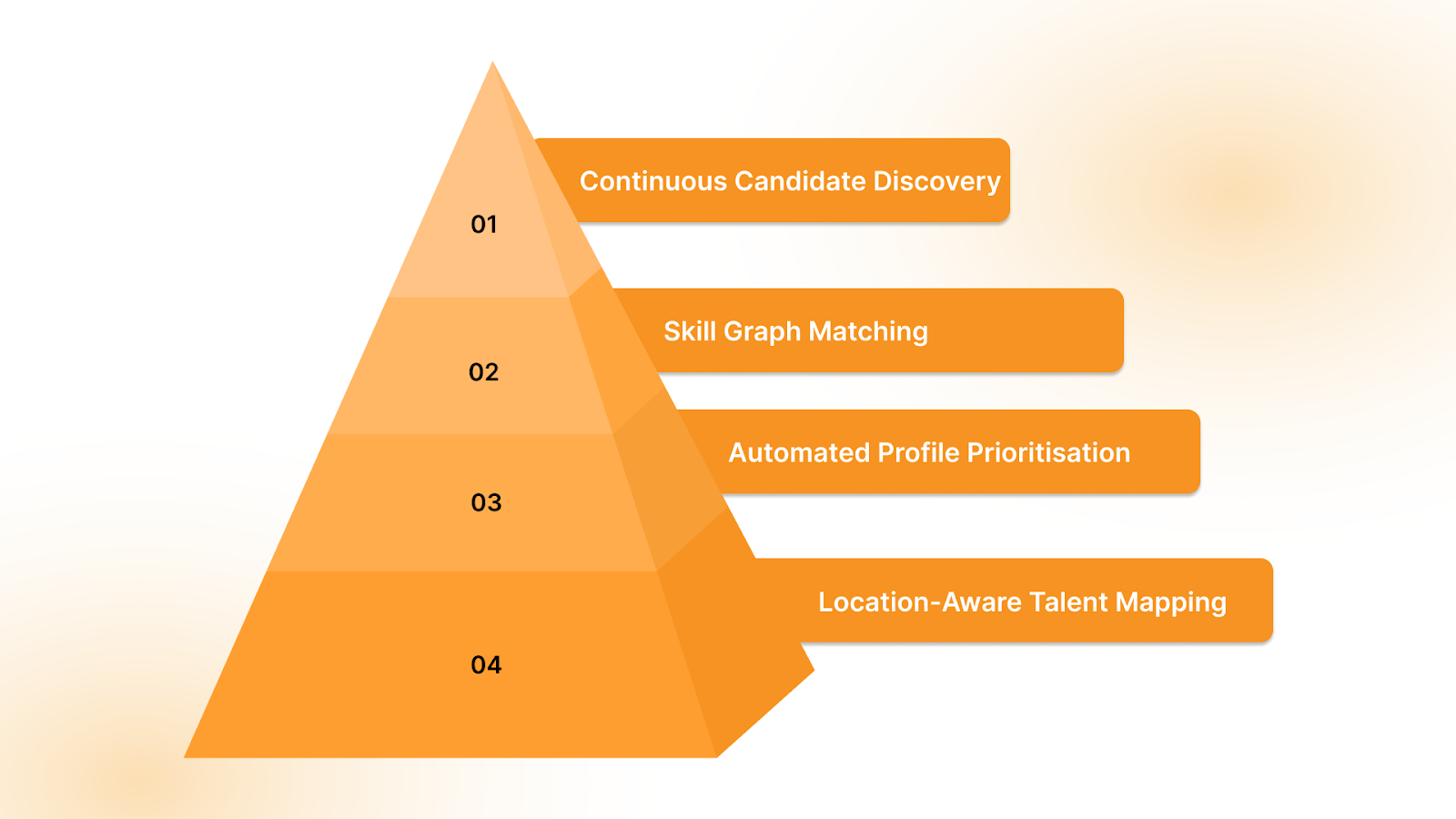
1. Continuous Candidate Discovery
AI systems observe skill movement patterns across platforms and automatically update hiring pools.
- Tracks engineers contributing to new frameworks or repositories.
- Identifies professionals shifting roles internally before job changes appear publicly.
- Detects specialists completing projects similar to open requirements.
Recruiters receive candidates at the readiness stage rather than the awareness stage.
2. Skill Graph Matching Instead of Keyword Filtering
Rather than matching titles, AI maps experience relationships between technologies and responsibilities.
- A platform reliability engineer matches infrastructure architect roles through incident response patterns.
- A data analyst with experimentation ownership qualifies for the product analytics hiring role.
- Backend engineers working on distributed systems match performance engineering roles.
This reduces false negatives caused by variations in job titles.
3. Automated Prioritisation of Qualified Profiles
Candidate ranking adjusts continuously based on the likelihood of interview success.
- Experience depth scores higher than resume keyword count.
- Recent project similarity raises shortlist priority.
- Offer acceptance probability influences outreach order.
Hiring managers review a small number of high-fit candidates rather than large filtered lists.
4. Location-Aware Talent Mapping
AI recruitment considers mobility and compensation alignment across geographies.
- Suggests local candidates for USA or UAE roles instead of relocation-dependent pipelines.
- Identifies remote-ready professionals for distributed teams.
- Flags compensation mismatches before outreach begins.
Example-based matching
Matching uses behavioural signals instead of declared titles.
- A cloud migration architect is identified from the infrastructure modernisation project history.
- A product analyst is identified through experiment ownership and accountability for metrics rather than designation.
The system shifts hiring from reactive search to predictive selection, reducing discovery time and improving the quality of shortlists.
Scaling a GCC team across regions requires a steady, tailored pipeline for backend engineers, product managers, data analysts, cloud architects, AI/ML specialists, and cybersecurity professionals. V3 Staffing runs SLA-based recruitment engines designed for specialist hiring across India, the USA, and the UAE. Talk to our recruitment team to plan your hiring roadmap.
Which Hiring Stages Are Now Automated?
Recruitment automation does not remove interviews. It removes the waiting time between steps. Earlier, recruiters searched, filtered, contacted, and scheduled sequentially. Now multiple stages run in parallel.
About 90% of employers already use automation to filter applications, meaning the first decision increasingly happens before a recruiter opens a profile.
1. Screening
Recruiters previously scanned profiles line by line. Automation reads patterns across projects, tools, and activity history.
Earlier Recruitment Flow
- The recruiter manually reads each resume to understand the candidate’s background and experience.
- They compare keywords from the resume to the job description to determine whether the applicant is a good fit for the role.
- Most applications are rejected at this stage because the experience does not closely match the project requirements.
Current Recruitment Flow
- The system first evaluates whether the candidate’s experience is relevant to the role and the project requirements.
- Applicants whose profiles do not match the required skills or experience are automatically filtered out.
- Recruiters then review a smaller set of qualified profiles and focus on evaluating capability rather than sorting through unrelated applications.
This change matters because resume review time can drop from about 15 minutes per candidate to under a minute. The recruiter’s role shifts from filtering to judgment.
2. Matching
Matching now asks a different question, such as whether the person has solved a similar problem before. Instead of focusing on exact titles, systems identify related work patterns.
Examples of adjacent skill detection
- Reliability engineer → platform engineering role
- Analytics owner → product analytics role
- Security operations → incident response leadership
The result is higher-quality shortlists. Companies report about a 20-40% improvement in hiring quality when AI matching is used.
3. Outreach
Recruiters once contacted every potential candidate equally. That wastes cycles because many candidates are not ready to move.
Now, outreach prioritises likelihood.
Systems check signals such as:
- Recent project completion.
- Profile updates.
- Activity frequency.
- Compensation movement patterns.
4. Shortlisting
Candidate lists no longer stay fixed after submission. Rankings change continuously as new information appears.
Dynamic shortlist behaviour
- New project evidence raises priority.
- Competing offers lower conversion probability.
- Urgent roles reorder candidate ranking.
Can AI Reduce Mis-Hires in Specialist Roles?
A mis-hire in specialist hiring rarely fails during the interview stage. It fails during execution when the person cannot operate at the expected scale, autonomy, or pace. Predictive hiring evaluates the likelihood of performance using behavioural and technical evidence before an offer is made.

Only a small fraction of hiring leaders report high confidence in hiring decisions at the time of offer. Predictive evaluation attempts to convert hiring from judgment-based selection to probability-based selection.
1. Role fit scoring
Instead of validating knowledge, systems analyse operating behaviour inside past projects. The goal is to determine whether the candidate has performed the same level of responsibility that the role demands.
Signals analysed include:
- Decision ownership across releases or production incidents.
- Infrastructure scale handled, such as user load or data volume.
- Complexity of problems solved, such as distributed failures or architecture tradeoffs.
- Independence level in execution without supervision.
This allows differentiation between a developer who contributed to a system and one who designed or stabilised it.
An engineer who fixed tickets inside a microservice is separated from one who handled production outages across services.
The scoring, therefore, measures operational maturity rather than tool familiarity.
2. Offer acceptance prediction
Late-stage offer rejection causes restart hiring cycles. Predictive engagement models detect commitment risk before negotiation.
Instead of relying on verbal confirmation, the system evaluates behaviour patterns.
Key indicators include:
- Compensation movement trajectory across the previous role.
- Interview scheduling urgency compared with peer candidates.
- Response delay variability during evaluation.
- Parallel interview density across companies.
For example, a candidate who schedules multiple final rounds within a short period has a lower acceptance probability, even if technically strong. Recruiters can prioritise high-conversion candidates for urgent roles while continuing to evaluate others.
3. Retention risk modelling
Joining does not equal staying. Retention modelling estimates whether the role aligns with the candidate’s working pattern.
The model studies behavioural consistency across employment history.
It detects:
- Short tenure following organisational changes.
- Preference for project-based environments versus stable teams.
- Movement after skill saturation rather than compensation change.
- Transition timing after product launch cycles.
A candidate frequently moving after release phases may suit transformation programmes but not platform ownership roles. This prevents replacing employees repeatedly within the same project lifecycle.
4. Project suitability scoring
Specialist hiring fails when the role type and working style mismatch, even if the technical ability matches.
The system maps execution style against assignment type.
For example, a strong migration engineer may perform poorly in a maintenance-heavy reliability role, not because of a skill gap but because of a motivation mismatch.
Why this reduces mis hires
Predictive hiring adds a fourth evaluation layer beyond interview performance:
- Capability proof
- Behaviour pattern
- Conversion likelihood
- Work style compatibility
When these four align, replacement hiring drops. The hiring decision becomes suitability selection rather than technical elimination.
Also Read: How India's AI Workforce is Shaping the Future of Jobs in 2026
What Changes for TA Leaders Managing Multi-Country Hiring?
Once hiring spans multiple countries, such as India, the USA, and the UAE, recruitment stops being a simple requisition workflow and becomes a capacity-planning exercise. Delivery schedules begin depending on hiring predictability rather than headcount approvals.
Unified hiring visibility
TA leaders no longer track requisitions. They track readiness. Instead of reviewing individual pipelines, they monitor hiring strength across locations.
Key operational uses:
- Compare hiring velocity between countries.
- Detect roles blocking programme milestones.
- Adjust hiring effort based on business deadlines.
Decision-making moves from recruiter updates to operational dashboards. Hiring status becomes a planning input for engineering and product teams.
Compensation intelligence
Offer acceptance is no longer purely brand-driven in global hiring markets. Timing and pay alignment matter more.
What leaders evaluate:
- Whether the role is competitively positioned locally.
- Whether urgency justifies compensation movement.
- Whether to hire locally or shift geography.
Salary benchmarking becomes part of workforce planning rather than negotiation handling.
Compliance awareness
Eligibility issues that arise after interviews waste weeks of hiring effort. Multi-country hiring shifts compliance checks earlier.
Teams pre-validate:
- Work authorisation feasibility.
- Employment structure restrictions.
- Location-specific hiring requirements.
This prevents restarting hiring cycles late in the process.
Pipeline prioritisation
Not all vacancies carry the same operational risk. Leaders now sequence hiring based on delivery dependency.
Operational priority usually follows impact:
- Platform engineering roles affecting releases.
- Product and analytics roles affecting roadmap commitments.
- Cybersecurity roles affecting audit readiness.
When hiring timelines begin affecting project schedules, organisations typically move to structured recruitment delivery. V3 Staffing supports GCC hiring across India, the USA, and the UAE, with defined 10-day time-to-hire targets, continuous pipelines, and measurable reporting and visibility.
Connect with the V3 Staffing team to plan predictable hiring timelines across your global centres.
When Should a GCC Move to AI-Led Hiring?
Manual hiring breaks when demand becomes unpredictable. The shift usually does not start from technology preference. It starts from operational pressure. Once hiring delays affect delivery commitments, recruitment becomes a capacity risk.
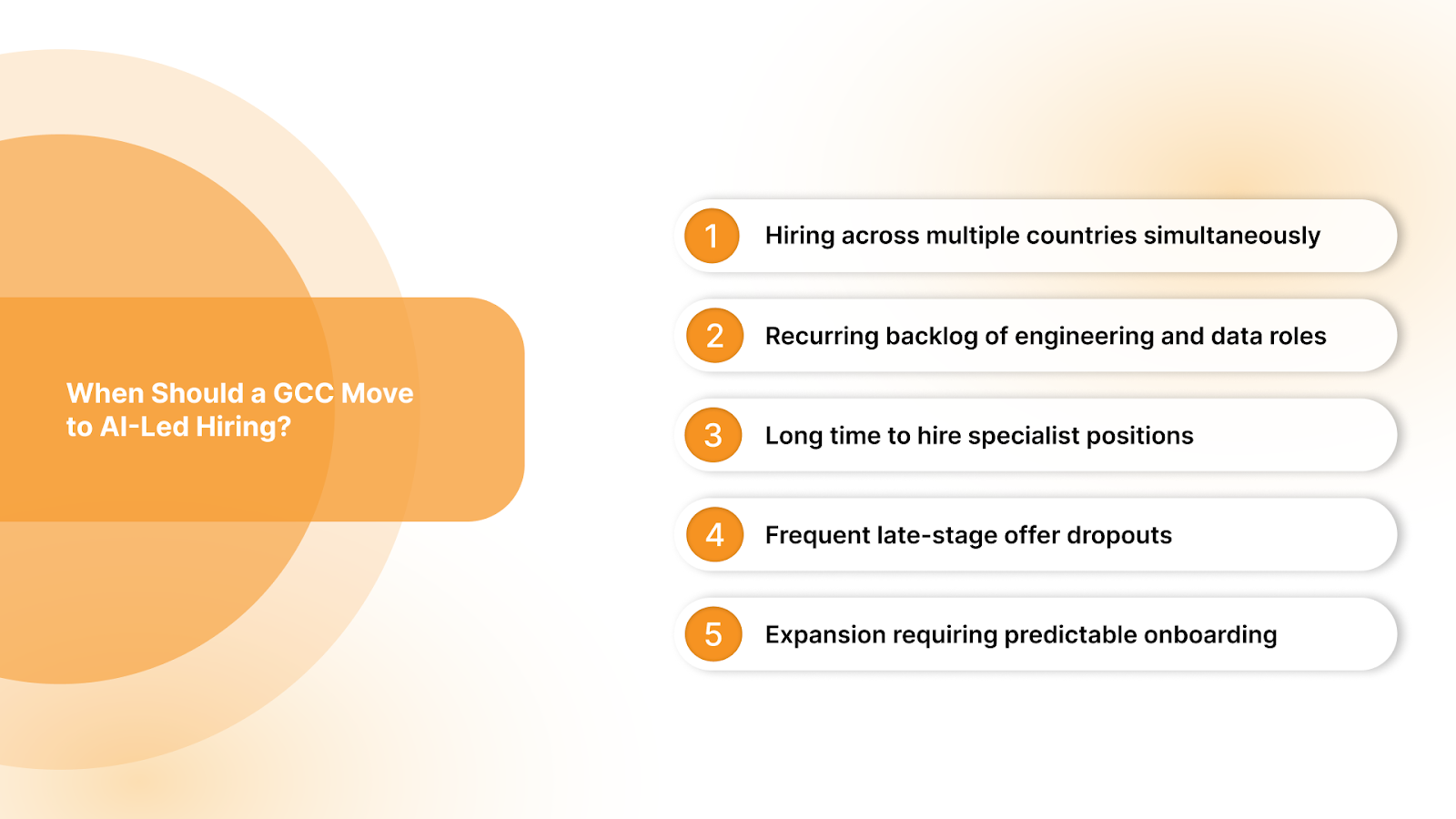
1. Hiring across multiple countries simultaneously
When teams hire in different countries, such as India and the UAE, pipelines collide. Candidates compare offers across markets, not within one geography.
- Compensation expectations vary by region.
- Acceptance timelines shrink due to competing offers.
- Recruiters repeat sourcing for each location.
Hiring becomes coordination rather than sourcing. The organisation now needs continuous talent mapping rather than per-role searches.
2. Recurring backlog of engineering and data roles
Backlog means demand is stable but supply is unstable.
- Platform engineering roles stay open across quarters.
- Data and analytics hiring blocks product releases.
- Cloud and AI specialists get multiple offers quickly.
About 70% of technical workers receive multiple job offers when they switch roles. This means hiring speed, not salary alone, decides outcomes.
3. Long time to hire specialist positions
Time-to-hire signals whether the hiring method aligns with the market.
- Roles repeatedly reopen after long cycles.
- Interview pipelines restart from scratch.
- Hiring teams screen large volumes but shortlist a few.
The average hiring time for tech roles can exceed 4 to 5 months. When the hiring duration exceeds the project planning duration, hiring becomes a problem
4. Frequent late-stage offer dropouts
Late dropouts indicate evaluation lag rather than candidate indecision.
- Candidates accept faster competitors.
- Negotiations restart repeatedly.
- Offer pipelines become unreliable.
5. Expansion requiring predictable onboarding
Scaling teams requires forecasting, not reacting.
- Release schedules depend on joining dates.
- Security coverage depends on staffing readiness.
- Product launches depend on analytics hiring.
What organisations typically do at this stage
Once hiring affects delivery predictability, companies move from ad hoc recruitment to structured hiring operations.
They adopt continuous pipelines and measurable hiring timelines, often working with specialised global recruitment partners such as V3 Staffing to maintain stable talent availability across locations.

How V3 Staffing Supports AI-Led GCC Hiring
Companies no longer rely on occasional resume support. They require structured hiring execution aligned with expansion timelines across multiple locations.
V3 Staffing operates as a recruitment delivery partner, maintaining hiring continuity rather than restarting searches for each requisition.
With over 16+ years of experience and 300+ enterprise clients served, the focus is on predictable hiring cycles and accurate role matching across India, the USA, and the UAE.
Here is how each service supports GCC hiring needs.
Permanent Recruitment
Builds stable core teams for long-term ownership roles across engineering, product, data, and security functions. Domain-experienced recruiters assess role relevance before submission, reducing internal screening effort. Supports sustained expansion rather than one-time hiring bursts.
Contract Staffing
Provides temporary capacity during migrations, implementations, and peak delivery cycles. Enables quick onboarding without increasing permanent headcount. Maintains a compliant employment lifecycle for short-duration programmes.
Employer of Record Services
Employer of Record (EOR) service lets companies hire in India without opening a local entity. V3 manages payroll, contracts, and statutory compliance, while you handle day-to-day work, helping teams expand quickly and stay compliant.
Recruitment Process Outsourcing (RPO)
Provides dedicated recruitment teams aligned with hiring plans and timelines. Delivers SLA based hiring with continuous pipeline availability. Reduces coordination load on internal TA teams during scaling.
Executive Search
Handles senior leadership hiring requiring decision ownership and strategic impact. Uses discreet headhunting and competency-based evaluation. Supports leadership hiring during GCC setup and expansion.
Conclusion
GCC hiring now depends on speed, accuracy, and predictability rather than sourcing volume. Global skill shortages continue to widen, with millions of specialised roles projected to remain unfilled worldwide, making reactive hiring cycles unreliable.
Organisations that move to structured, data-informed recruitment pipelines reduce delays, avoid restart searches, and stabilise delivery timelines across locations.
AI-led recruitment shifts hiring from vacancy filling to workforce planning, especially for engineering, product, data, cloud, AI/ML, and cybersecurity roles. V3 Staffing supports continuous GCC hiring across India, the USA, and the UAE with measurable timelines and accountable delivery.
Contact us to plan your hiring roadmap.